
In industrial, construction, and power plant projects, accurate land surveying is a cornerstone of design, execution, and monitoring. Aseman-Rasad Hadi, equipped with advanced drones and a professional team, provides aerial mapping services with the highest accuracy and quality—a method that offers significant advantages in speed, safety, coverage, and cost compared to traditional ground surveying.
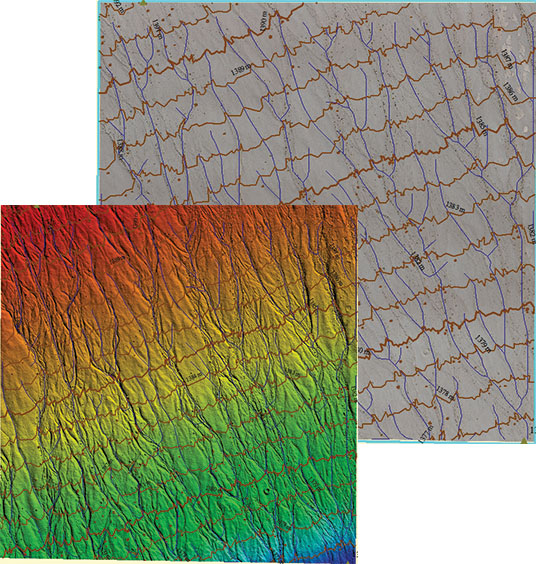
Aerial mapping with drones is a process in which drones equipped with high-resolution cameras and GNSS/RTK positioning systems fly over the target area and capture high-resolution aerial images. These images are then processed using specialized software to generate outputs such as:
These outputs are essential for project design, analysis, and documentation.
Large-scale projects that may take days or weeks with ground surveying can be completed in just a few hours with drones.
Drones provide consistent coverage across the entire site, including hard-to-reach, steep, or hazardous areas inaccessible to ground surveyors.
In projects such as solar plants, refineries, or mines, human presence may involve risks. Aerial mapping eliminates the need for physical presence, ensuring team safety.
With RTK-equipped drones and advanced image processing software, aerial mapping achieves centimeter-level accuracy—fully reliable for engineering design, volumetric calculations, and project progress control.
Outputs such as orthophotos and 3D models are not only technically useful but also highly effective for reporting, documentation, and presentation to clients or regulatory authorities.
In solar power plant projects, aerial mapping plays a key role at different stages:
In industrial projects such as refineries, mines, transmission lines, and infrastructure facilities, aerial mapping enables fast and accurate monitoring.
Aseman-Rasad Hadi has successfully executed aerial mapping in landmark projects, including:
This track record has earned the trust of major clients and established us as a specialized reference in this field.
For expert consultation, service booking, or sample maps, contact us. We are here to elevate your project with precision, speed, and safety.