




Introduction
Solar energy, as one of the most important renewable resources in the world, has experienced remarkable growth in recent years. Solar power plants, both small and large-scale, are expanding rapidly, and solar panels—being the heart of these plants—play a vital role in energy production. Given the significant investments in this sector, quality control of solar panels has become crucial. One of the key tools in this process is the EL (Electroluminescence) Test, which enables the detection of hidden defects in solar cells.
This article provides a comprehensive overview of EL testing, its applications, benefits, execution methods, the role of image processing and artificial intelligence in analyzing results, and its significance in the solar energy industry.
Definition of EL Testing
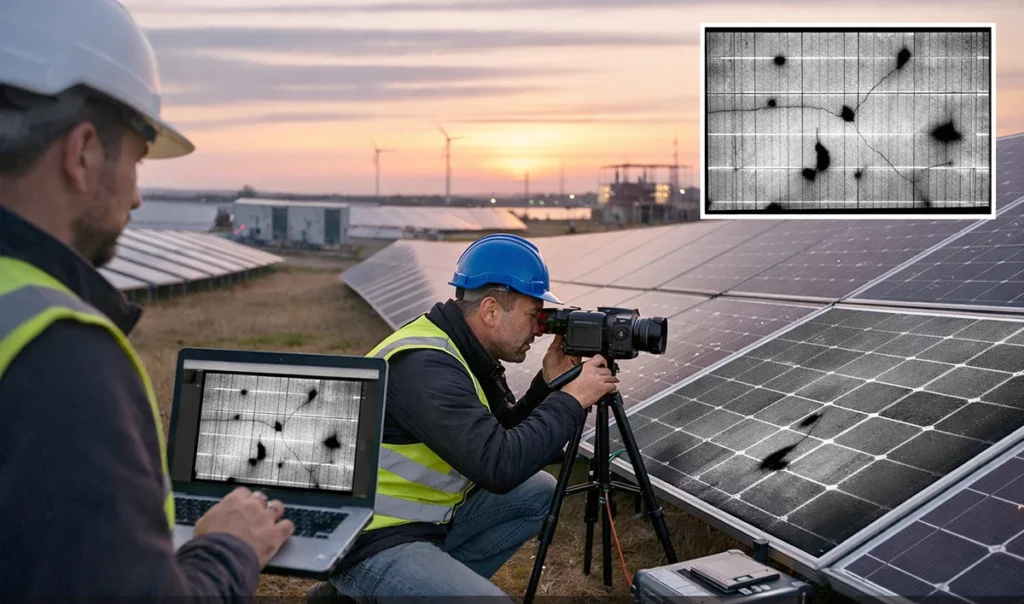
The EL test, or electroluminescence, is a method in which an electric current is applied to a solar panel, causing the cells to emit infrared light. This emission is captured by sensitive cameras, and the resulting image—similar to a medical X-ray—reveals internal defects within the cells.
Key Features of EL Testing
Non-destructive: EL testing does not damage the panel.
High accuracy: It can detect micro-cracks and internal connection issues.
Wide applicability: Used both in manufacturing plants and operational solar farms.
Types of EL Testing
1. Factory EL Testing
In solar panel production lines, EL testing is part of the quality control process. Each panel undergoes this test before leaving the factory to identify and correct potential defects.
2. Portable EL Testing
In solar farms, inspection teams use portable EL devices to examine panels on-site. This method is highly useful for periodic monitoring and identifying faulty panels.
3. AI-Based EL Testing
With advancements in image processing, artificial intelligence algorithms can now analyze EL images and automatically detect defects. This approach improves inspection speed and accuracy while reducing human error.
Defects Detectable by EL Testing
- Cell micro-cracks: Tiny cracks formed during manufacturing or transportation.
- Internal connection defects: Broken metallic lines or weak soldering.
- Cell non-uniformity: Differences in material quality or production processes.
- Mechanical stress defects: Damage caused by installation or environmental conditions.
The Role of Image Processing in EL Testing
Image processing is a powerful tool that enables more precise analysis of EL images. Using advanced algorithms, it is possible to:
- Automatically detect cracks and fractures.
- Measure and compare cell emission intensity.
- Generate defect heat maps.
- Store data for statistical analysis and lifespan prediction of panels.
Artificial Intelligence and Machine Learning
Combining image processing with machine learning algorithms is revolutionizing EL testing. Intelligent systems can identify complex defect patterns and even predict which panels are likely to fail in the future.
Importance of EL Testing in Solar Farms
Conducting EL testing in solar farms offers multiple benefits:
Improved plant efficiency: Identifying and replacing defective panels.
Reduced maintenance costs: Preventing defect propagation and avoiding costly repairs.
Extended plant lifespan: Preserving panel quality over the long term.
Investor confidence: Providing accurate reports on plant condition.
Comparison of EL Testing with Other Inspection Methods
Thermography: Useful for detecting hotspots but cannot reveal micro-cracks.
IV-Curve Testing: Evaluates electrical performance but does not show structural cell details.
Visual Inspection: Quick and inexpensive but lacks precision.
Thus, EL testing is recognized as the most accurate method for detecting internal defects in solar cells.
Challenges and Limitations
Equipment cost: Infrared-sensitive cameras and image processing systems are expensive.
Need for expertise: Analyzing EL images requires technical knowledge and experience.
Time-consuming: Testing all panels in large solar farms can be lengthy.
The Future of EL Testing
With advancements in artificial intelligence, machine learning, and robotics, the future of EL testing looks promising:
- Automated inspection systems: Robots and drones will be able to perform EL testing autonomously.
- Predictive analysis: Algorithms will forecast the useful lifespan of panels.
- Integration with other methods: Combining EL testing with thermography and IV-Curve testing for comprehensive reporting.
Conclusion
EL testing of solar panels is a vital tool in the solar energy industry. This method enables precise detection of internal cell defects and plays a key role in improving efficiency, reducing costs, and ensuring investor confidence. The integration of EL testing with modern technologies such as image processing and artificial intelligence promises a more reliable and efficient future for solar farms.